
Introduction
A transformer factory acceptance test is your last chance to check a unit against the purchase order before it leaves the works. Once it’s on a truck, every problem becomes a site problem, with cranes, shutdowns and long emails about who pays.
This guide walks you through a witnessed FAT the way a senior inspector would brief a colleague: what to prepare, which transformer routine tests to watch, what the readings should tell you, and what to sign before you leave.
It’s written for the distribution transformers most buyers order: mineral-oil units up to 2500 kVA and 33 kV under IS 1180 (Part 1):2014, with a short note for larger power transformers. If you haven’t sized the unit yet, start with choosing the right kVA rating. The BIS transformer standards overview is a handy companion to keep open.
Table of Contents:
- What Is a Transformer Factory Acceptance Test?
- Routine, Type and Special Tests: What You'll Actually Witness
- Transformer routine tests and their IS 2026 test methods
- Type and special tests
- Transformer FAT Checklist: Before You Travel
- What to Witness During a Transformer Factory Acceptance Test
- Signing Off a Transformer FAT: Documents to Collect
- Who Should Attend a Transformer Factory Acceptance Test?
What Is a Transformer Factory Acceptance Test?
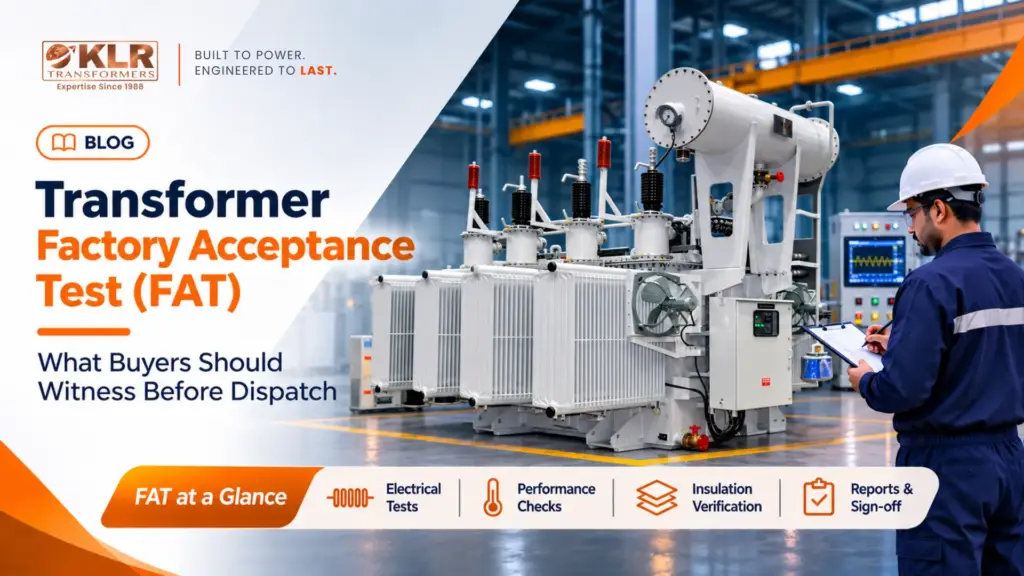
A transformer factory acceptance test (FAT) is a set of tests done at the manufacturer’s works, usually witnessed by the buyer or a third-party inspector, to prove a finished transformer meets its specification and guaranteed values before dispatch. For Indian distribution transformers, it covers the IS 1180 routine tests, performed using IS 2026 test methods.
Routine, Type and Special Tests: What You'll Actually Witness
Standards sort transformer tests into three groups. The IEC 60076-1 test classification puts it simply: routine tests are done on every unit, type tests on one unit of a design, and special tests only when buyer and manufacturer agree.
At most FATs, you witness routine tests and review type test reports.
Transformer routine tests and their IS 2026 test methods
According to the IS 1180 test requirements, the routine tests are:
- Winding resistance — IS 2026 (Part 1)
- Voltage ratio and phase displacement (vector group) — IS 2026 (Part 1)
- Short-circuit impedance and load loss at 50% and 100% load — IS 2026 (Part 1)
- No-load loss and no-load current — IS 2026 (Part 1)
- Insulation resistance — IS 2026 (Part 1)
- Induced overvoltage withstand — IS 2026 (Part 3)
- Separate-source voltage withstand — IS 2026 (Part 3)
- Pressure test and oil leakage test
Type and special tests
- Type tests (one unit of the design): lightning impulse (IS 2026 Part 3), temperature rise (Part 2), short-circuit withstand up to 200 kVA (Part 5) and pressure test.
- Special tests (by agreement): sound level (Part 10), short-circuit withstand above 200 kVA, no-load current at 112.5% voltage, paint adhesion, and oil breakdown voltage (BDV) and moisture content.
If your order calls for a type test on a unit from your lot, it becomes a witness point too. Plan for it, because it adds days, not hours.
Larger units: For power transformers above the IS 1180 range, the IS 2026 power transformer standards (Parts 1, 2, 3, 5 and 10) govern the IS 2026 tests directly. The witness list grows, so agree it in the quality assurance plan at the order stage.
Dry-type units: These follow IS 2026 (Part 11):2021 (which replaced the withdrawn IS 11171), though the witnessing approach below still applies.
Transformer FAT Checklist: Before You Travel
Most FAT trouble starts before anyone reaches the factory. Use this transformer FAT checklist a week or two ahead:
- Agree the inspection and test plan. Mark witness points (W) and hold points (H) in the quality assurance plan, and attach it to the purchase order.
- Get the inspection call in writing. It should list serial numbers, tests, date and test bay.
- Carry the right documents. Purchase order, approved general arrangement drawing, guaranteed technical particulars (GTP) and the rating plate drawing.
- Check instrument calibration. Ask for certificates for the power analyser, CTs/PTs, resistance meter and HV kit. They should be current on test day.
- Check the laboratory’s accreditation. Many utilities ask bidders for type test reports from NABL-accredited labs;
- Review type test reports. Confirm they match your design, rating and losses, and fall within the validity period your specification allows.
- Agree the sample. For lot orders, settle how many units you’ll witness and how they’ll be picked.
- Plan any stage inspection. Some buyers also check the core and windings before tanking, ahead of the final tests.
What to Witness During a Transformer Factory Acceptance Test
Here’s the order most inspectors follow, and what to watch at each step.
1. Visual and dimensional check
- Rating plate and terminal marking plate match the PO and GTP
- Dimensions and fittings match the approved drawing
- Conservator, breather, oil level gauge, earthing points, valves and bushings in place
- No paint damage, weld spatter or oil seepage
2. Winding resistance
Readings should be closely balanced across phases. A noticeable imbalance usually points to a poor joint or tap connection. Note the oil temperature, because these values are used later to correct losses to 75°C.
3. Ratio, polarity and vector group
Check ratio on every tap, not just the principal tap. The tolerance on the principal tap is tight, the lesser of ±0.5% of the declared ratio or 1/10th of the actual percentage impedance (for example, ±0.45% on a 4.5% impedance unit), so a reading outside it isn’t a “rounding” issue. Confirm the vector group matches the rating plate.
4. No-load loss and no-load current
Measured at rated voltage and frequency from the LV side. Ask how the test team corrects for voltage waveform, and see that the correction appears on the sheet.
5. Load loss and impedance
This is where money is involved. Load loss is measured at rated current and corrected to 75°C. IS 1180 caps the total loss at 50% and 100% load for each energy efficiency level.
Compare the results with your guaranteed loss values and the IS 1180 limit for your level. For example, the BIS overview lists a 100 kVA, 11 kV class, 4.5% impedance unit at Level 1 with maximum total losses of 475 W at 50% load and 1,650 W at 100% load. Check the loss tolerance and penalty clauses in your PO before test day, not after.
6. Insulation resistance and dielectric tests
Watch the insulation resistance readings, then the separate-source and induced overvoltage tests. A pass means the full test voltage is held for the full duration with no collapse, flashover or abnormal sound. Stand where the test engineer tells you; this is HV work.
7. Pressure and oil leakage test
Walk around the tank. Check gaskets, welds, radiator joints and valve flanges for seepage. A small weep at the factory becomes a steady leak after a monsoon.
8. Oil tests (if in scope)
If your order includes BDV and moisture tests, witness the sample being drawn, not just the result.
Signing Off a Transformer FAT: Documents to Collect
Don’t sign the inspection report until you have:
- A test report for each serial number, signed by the manufacturer’s QA
- Loss calculation sheets showing the temperature correction
- An instrument list with calibration due dates
- A list of any deviations or non-conformities, and how each one was closed
- Photographs of the rating plate and the unit on the test bay
- Clear next steps for dispatch clearance such as the MDCC (Material Dispatch Clearance Certificate) your utility issues.
Put it in the purchase order. Witness and hold points, accredited lab or calibrated instruments, guaranteed losses and penalties, retest and rejection rules, and who pays for a repeat visit. If you’re buying BIS-certified transformers, ask for the licence details in the PO too.
Who Should Attend a Transformer Factory Acceptance Test?
A good FAT team is small and clear on roles:
- Buyer’s electrical engineer: owns the technical sign-off
- Third-party inspection agency or consultant: independent witness, often required by utilities and EPC contracts
- Project or procurement manager: handles commercial points such as loss penalties and delivery
- Junior engineers: a FAT is one of the best ways to learn what “good” looks like
Visiting the works is also a quiet test of the supplier. A tidy test bay, current calibration stickers and a test engineer who explains readings without being asked tell you a lot about choosing a transformer manufacturer.
Key Takeaways
- Witness routine tests on the unit you’re buying; review type test reports for the design.
- Fix witness points, loss guarantees and retest rules in the PO.
- Load loss at 75°C, compared with your guaranteed losses and the IS 1180 limit, is the most important reading.
- Leave with signed reports, calibration records and closed deviations.
Planning a witnessed test? Share your requirements and the KLR team will help you agree the test plan for your order.
FAQ Section
A factory acceptance test happens at the manufacturer’s works before dispatch and proves the transformer meets its specification and guaranteed values. A site acceptance test happens after installation and checks that the unit arrived undamaged and was installed correctly, typically through insulation resistance, ratio and oil tests before energisation.
Witness all IS 1180 routine tests if you can: winding resistance, ratio and vector group, no-load loss and current, load loss and impedance, insulation resistance, separate-source and induced overvoltage tests, and the pressure and oil leakage test. If time is short, prioritise load loss, no-load loss and dielectric tests.
No. Type tests such as temperature rise, lightning impulse and short-circuit withstand are done on one unit of a design. At a normal FAT, you review the type test reports and confirm they match your design and rating. A type test is witnessed only if your purchase order specifically asks for one.
For a single distribution transformer, the routine tests usually fit into one working day, including the visual check and paperwork. Lot inspections, type tests or special tests add time. Temperature rise testing alone can take a full day per unit, so plan travel only after confirming the test schedule.
The inspector records a non-conformity, the manufacturer investigates and corrects the cause, and the test is repeated, often with a fresh inspection call. Your purchase order should say whether failed units are rejected or repaired, how many retests are allowed and who pays for the extra visit.
Yes, if your purchase order allows it. A live video link can show the instrument readings and nameplate during the factory acceptance test (FAT). Agree the tests, camera control and report beforehand. Some tenders still require an inspector to attend in person.
For routine tests at the factory, buyers mainly check that test instruments carry current calibration certificates, ideally from NABL-accredited calibration labs. For type tests, many Indian utilities, including Telangana’s TGSPDCL, require certificates from NABL-accredited or recognised international laboratories. Always confirm what your specification demands.