
Introduction
Two quotes for the same 1000 kVA transformer land on your desk. One costs more. Is it worth it?
The answer often sits in one line of the datasheet: the distribution transformer energy efficiency level. It tells you how much power the unit is allowed to waste. That waste shows up on your electricity bill every month for 25 years or more.
Decoding IS 1180 loss tiers and Bureau of Energy Efficiency (BEE) star ratings is the key to cutting electricity costs for the next 20 years. Here is how to turn technical transformer specs into actual rupees before you sign a purchase order.
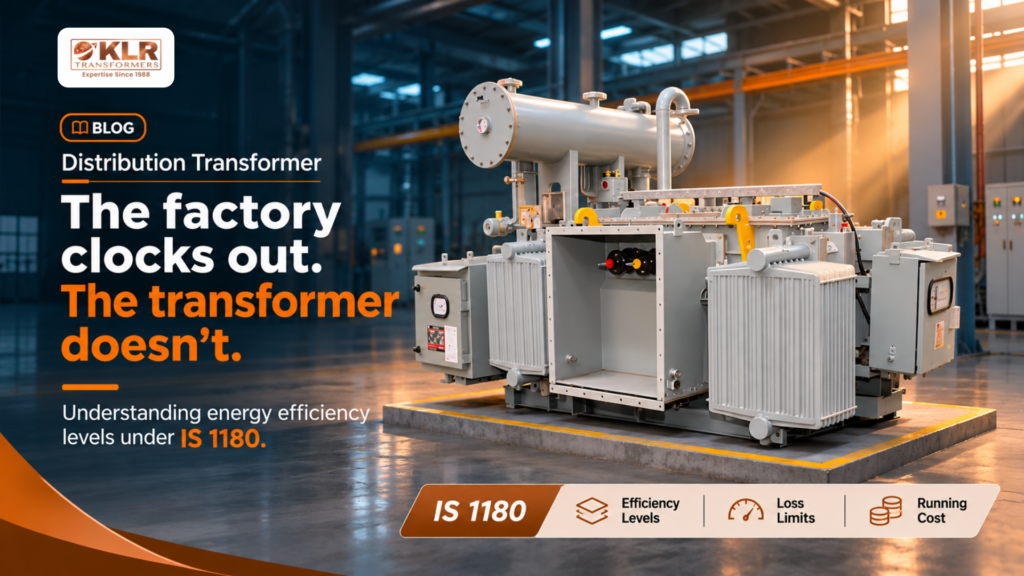
Image suggestion: Photo of an oil-immersed distribution transformer at an industrial substation, rating plate visible. Alt text: “Oil-immersed distribution transformer at an industrial plant substation with rating plate showing energy efficiency level”
Table of Contents:
- What Is a Distribution Transformer Energy Efficiency Level?
- Two Losses Every Buyer Should Understand
- IS 1180 Loss Limits: The Five Energy Efficiency Levels
- Transformer Star Rating: How IS 1180 Links to BEE
- What Each Level Means in Rupees: A Worked Example
- How to Choose the Right Distribution Transformer Energy Efficiency Level
- Compare Running Cost, Not Just Price
- How KLR Can Help
What Is a Distribution Transformer Energy Efficiency Level?
Think of a transformer’s IS 1180 efficiency level as a grade for how much power it wastes. Set by the Bureau of Indian Standards (BIS) for oil-immersed transformers up to 2,500 kVA (33 kV), the standard ranks performance across five tiers. Each tier puts a strict ceiling on energy losses at both half load (50%) and full load (100%), ranging from Level 1 (baseline efficiency) to Level 5 (maximum efficiency).
Two Losses Every Buyer Should Understand
Every transformer wastes some energy as heat. That waste comes in two kinds.
- No-load loss is the power the core uses just to stay switched on. You pay for it every hour the transformer is energised, even when your plant is idle.
- Load loss is the heat in the windings when current flows. It rises fast with load. Double the load and this loss roughly quadruples.
IS 1180 sets strict maximum limits on total losses at two distinct operating points: 50% load and 100% load, rather than capping core and winding losses separately. This gives designers flexibility in how they balance core steel and winding conductors. However, because your plant’s actual operating profile dictates which loss type dominates your bill, you should evaluate both loss figures individually on every quote.
IS 1180 Loss Limits: The Five Energy Efficiency Levels
Watch out for outdated specs in older tender documents: IS 1180 moved from a 3-tier system to a strict 5-level efficiency scale. Because loss limits were tightened across the board, today’s baseline Level 1 is equivalent to what used to be called “Level 2” under older standards.
The table below shows the current maximum loss caps for a typical 1,000 kVA (11 kV class) unit:
|
What a “BIS Level 2 Transformer” Means in a Tender
When a project tender or DISCOM specifies a “BIS Level 2” transformer, it is asking for a unit certified by the Bureau of Indian Standards that strictly complies with Level 2 loss caps.
Watch Out for Outdated Specs:
Many RFQs still copy-paste older tender templates. Before 2021, India used an older 3-tier system where “Level 2” meant something entirely different than it does today. Today, the scale is simple: Levels 1 through 5 match BEE 1-Star through 5-Star ratings directly.
If you see mixed phrasing like “Level 2 (Star 1)” in a quote or tender, you are looking at an outdated spec. Always confirm with your vendor that quotes are based on the latest 5-level IS 1180 standard so you don’t end up comparing apples to oranges.
Transformer Star Rating: How IS 1180 Links to BEE
The Bureau of Energy Efficiency (BEE) runs India’s star labelling scheme. Under the amended IS 1180, Levels 1 to 5 correspond to 1-star to 5-star labels.
Star labels are not limited to small units. Government e-Marketplace (GeM) listings for 11 kV units above 200 kVA and up to 2,500 kVA carry both an efficiency level and a BEE star rating.
Two regulatory points matter for buyers:
- The Ministry of Power’s 2009 standard for distribution transformers, issued under the Energy Conservation Act, 2001, was revised on 16 December 2016 and amended again in 2017 and 2020.
- A further amendment dated 23 December 2025 adds a new loss table for units up to 11 kV class, from 16 kVA to 2,500 kVA. It applies from 1 January 2027 to 31 December 2029. Check it before you finalise orders due for delivery in 2027.
What Each Level Means in Rupees: A Worked Example
Percentages hide the money. So let’s use rupees.
Assume your plant runs a 1000 kVA transformer at about half load, around the clock. That’s 8,760 hours a year. Assume power costs ₹8 per kWh. Take each level’s maximum loss at 50% load.
|
Moving from Level 1 to Level 3 saves about 2,890 kWh a year. That’s roughly ₹23,100 every year. Over a 25-year life, the simple total comes close to ₹5.8 lakh.
There’s a carbon benefit too. At the Central Electricity Authority’s (CEA) grid average of about 0.73 tonnes of CO₂ per MWh, saving 2,890 kWh a year avoids roughly 2 tonnes of CO₂ annually. That figure can go straight into your sustainability reporting.
Now going back to your two quotes, if the higher-level unit costs ₹1 lakh more, it pays back in a little over four years at this load. If it costs ₹4 lakh more, the case is much weaker.
Your numbers will differ. Tariffs vary by state and contract. Load profile matters most. A lightly loaded transformer spends most of its life paying no-load loss. A heavily loaded one pays far more load loss.
A Simple Formula for Your Own Quotes
Use the guaranteed losses from each supplier’s datasheet:
Annual loss (kWh) = [No-load loss (W) × hours energised + Load loss (W) × (average load ÷ rated load)² × hours on load] ÷ 1,000
Multiply the result by your tariff. Then compare it with the price difference. If you have meter data, use the root-mean-square (RMS) load for a more accurate figure.
How to Choose the Right Distribution Transformer Energy Efficiency Level
Answer these questions before you issue an RFQ:
- What will the average load be? Long periods at light load favour low no-load loss.
- How many hours a year will the unit stay energised?
- What do you pay per unit of electricity, all charges included?
- Does your utility, project contract or green-building target require a minimum level or star rating?
- Which edition and amendment of IS 1180 does your specification cite?
Then ask every bidder for guaranteed no-load and load losses, not just a level. Under CEA’s standard specifications, IS 1180 maximum losses carry no positive tolerance. Also ask for each supplier’s BIS licence details. Confirm the licence covers the current amendment of IS 1180 and the level being quoted.
Our guide shows how to verify a supplier’s BIS certification, from licence number to nameplate.
Equal-level quotes can still differ. Two Level 2 units may split their losses differently. The one with lower no-load loss may suit a plant that runs lightly loaded at night and on weekends.
Compare Running Cost, Not Just Price
- An IS 1180 energy efficiency level caps total losses at 50% and 100% load.
- Five levels now exist, linked to BEE 1-star to 5-star labels. Older specs may use the old three-level numbering.
- A higher level is not automatically better value. It depends on your load, hours and tariff.
- Put loss figures into rupees before you compare prices.
The right choice is the one that fits how your plant actually runs.
How KLR Can Help
KLR Transformers designs and manufactures transformers, with an engineering legacy of more than 45 years. Our BIS-certified distribution transformers cover 500 kVA to 2,500 kVA, up to 33 kV, and are built and routine-tested to IS 1180.
Share your load profile, operating hours and tariff with us. We’ll respond with a technical proposal within one business day, so you can weigh your options on running cost, not just price. Type test reports are available to review.
Share your requirements with KLR or explore our distribution transformer range.
FAQ Section
A BIS Level 2 transformer is a distribution transformer whose total losses at 50% and 100% load stay within the Energy Efficiency Level 2 limits of IS 1180 (Part 1). It carries the BIS Standard Mark for that level. Under the amended standard, Level 2 corresponds to a BEE 2-star label.
After Amendment 4 to IS 1180 (Part 1):2014, the standard has five energy efficiency levels. Levels 1, 2, 3, 4 and 5 correspond to BEE 1-star, 2-star, 3-star, 4-star and 5-star labels. Older specifications used three levels mapped differently, so always check which edition a document cites.
Most distribution transformers rarely run at full load for long. Setting a limit at 50% load reflects typical working conditions, while the 100% limit covers peak periods. Together, the two points force a balanced design, so the transformer cannot hide high no-load loss behind low load loss, or the reverse.
Not always. A higher level saves more energy, but the value depends on your average load, operating hours and electricity tariff. Convert each quote’s guaranteed losses into an annual rupee figure, then compare that saving with the price difference. If payback is short compared with the transformer’s life, the higher level usually makes sense.
No. IS 1180 (Part 1) covers outdoor, mineral-oil-immersed distribution transformers up to 2,500 kVA and 33 kV. BIS publishes a separate part for natural and synthetic ester-filled units. Dry-type transformers fall under a different Indian Standard, so check the right document before setting loss limits for those.
Check the rating plate and BIS Standard Mark, which state the energy efficiency level. Look for the BEE star label where it applies. Then ask the supplier for routine test reports showing measured no-load and load losses. Compare those figures with the IS 1180 limits for that kVA rating and voltage class. You can also ask for the supplier’s BIS licence to confirm it covers the current amendment.
Yes. A Ministry of Power amendment dated 23 December 2025 adds a new loss table for transformers up to 11 kV class, from 16 kVA to 2,500 kVA. It applies from 1 January 2027 to 31 December 2029. Buyers placing orders for 2027 delivery should confirm which star bands will apply.