
Introduction
Transformers don’t fail out of nowhere. By the time a plant notices smoke, a protection relay trips, or an unexpected shutdown brings operations to a stop, the problem has often been developing quietly for months or even years.
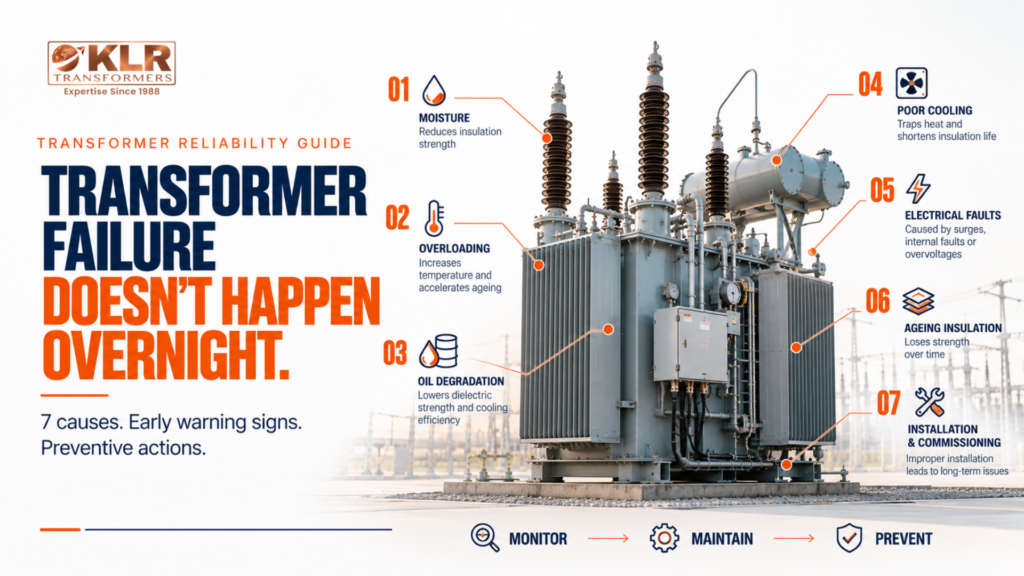
Understanding why transformers fail is the first step to preventing these problems. Most failures can be traced back to a few recurring issues: moisture ingress, overloading, degraded oil, poor cooling, electrical faults, ageing insulation, and installation errors.
The good news is that many transformer failures can be reduced or prevented through proper design, protection, monitoring and preventive maintenance.This guide walks plant engineers, maintenance heads, and operations teams through why transformers fail, the warning signs to watch out for, and how a structured maintenance programme keeps your assets running for decades not just years.
How a transformer performs over time depends on how it is designed, tested, protected, monitored and used.
Table of Contents:
What Causes Most Transformer Failures in Industrial Plants?
The most common transformer breakdown causes are moisture ingress in the winding insulation, sustained overloading beyond rated capacity, deteriorating transformer oil (low BDV), inadequate cooling, and ageing insulation that has gone unmonitored. However, most of these failures can be prevented with a planned maintenance programme.
These factors are often connected. For example, overloading makes a transformer run hotter, which can speed up oil deterioration. Moisture in the insulation can reduce insulation resistance and make the windings more vulnerable to electrical stress. So, preventing transformer failure involves more than just resolving one problem and moving on. It requires regular monitoring and maintenance to identify issues before they become more serious.
1. Moisture Ingress and Insulation Degradation
Moisture is one of the biggest threats to an oil-filled transformer. Even a small amount of water in the cellulose paper insulation can reduce its dielectric strength and speed up insulation ageing.
Moisture can enter the transformer through:
- Damaged or saturated silica gel breathers
- Loose gaskets and seals
- Condensation caused by temperature changes
- Inadequate drying during manufacturing or repair
Prevention: Proper drying before the transformer is put into service is important to keep moisture from becoming a long-term problem.
Proper drying of the active parts before tanking and oil filling is important for controlling moisture in the insulation system. Once the transformer is in service, regular breather checks, moisture testing, and gasket inspections help prevent moisture ingress. Additionally, oil sampling and BDV testing, insulation resistance measurement, silica gel breather inspection and replacement, and related transformer condition checks are all included in KLR’s annual maintenance contracts.
2. Overloading and Thermal Stress
Every transformer is designed to handle a specific load. When it runs above that limit for long periods, the extra heat puts more stress on the insulation and can shorten its expected life. As a general rule of thumb, for every 6–8°C increase above the rated hot-spot temperature, the expected life of the insulation can roughly be cut in half.
Prevention:
- Choose a transformer with enough capacity to accommodate future load growth.
- Monitor actual load patterns instead of relying only on the nameplate rating.
- Regularly monitor winding hot-spot and top-oil temperatures.
- Use fibre-optic temperature monitoring when more accurate hot-spot readings are required.
- For critical transformers, consider online DGA and transformer monitoring to detect developing issues early.
3. Poor Transformer Oil Condition
Transformer oil performs two important jobs – it provides insulation and helps keep the transformer cool. When the oil starts to degrade, both functions can be affected.
Signs of poor oil condition include low Breakdown Voltage (BDV), increasing moisture content, rising acidity, and abnormal levels of dissolved gases such as hydrogen, acetylene, and methane. These can indicate overheating, arcing, or other developing problems inside the transformer.
Prevention: Regular BDV and Karl Fischer testing can help identify changes in oil condition early. When oil has already degraded, appropriate oil filtration or treatment methods may be used to remove moisture and contaminants and help maintain the insulating properties of transformer oil. For critical transformers, online DGA monitoring can be considered to continuously track dissolved fault gases and help identify developing issues early.
KLR Transformers provides mobile oil filtration and treatment services, including hot-oil circulation filtration, vacuum oil filtration, BDV improvement, moisture measurement, acidity testing and DGA sampling.
4. Inadequate Cooling and Ventilation
A transformer needs to release heat efficiently to operate reliably. Blocked radiators, poorly working cooling fans, inadequate ventilation in covered substations, and dust buildup can all affect heat dissipation and put additional thermal stress on the transformer.
For larger or more demanding applications, the cooling system needs to suit the transformer’s operating conditions. Depending on the application, KLR transformers can be equipped with different cooling systems. KLR’s furnace transformers are listed with ONAN, ONAF, OFAF and OFWF cooling options, while its wind power transformers are listed with ONAN/ONAF cooling.
Prevention:
- Keep radiator fins and cooling fans free from dust and buildup.
- Check cooling fans and pumps regularly to make sure they are working properly.
- Make sure the transformer room or substation has adequate ventilation for the site’s operating and ambient conditions, especially in coastal and high-humidity areas.
KLR also supplies and supports cooling-related components such as radiators and cooling fans as part of its spare-parts and servicing capabilities.
5. Short Circuits and Electrical Faults
External short circuits caused by downstream faults, lightning strikes, or switching surges can put the windings under intense mechanical and thermal stress within a very short time. Even when the transformer does not fail immediately, repeated electrical faults can loosen the winding clamping and increase the risk of problems later.
Prevention:
- Keep protection relays and coordination settings up to date.
- Check surge arresters, grounding and other protection systems regularly.
- Inspect winding clamping during major maintenance.
- Conduct appropriate transformer testing to identify developing electrical or insulation-related issues.
KLR’s testing and commissioning services include insulation resistance (IR), breakdown voltage (BDV), winding resistance, voltage ratio and polarity verification, and OLTC performance testing. Partial discharge measurement is also carried out when required.
6. Ageing Insulation and Lack of Preventive Maintenance
Transformer ageing doesn’t depend on calendar age alone. A transformer that operates for long periods near its thermal limits can age significantly faster than a similarly aged unit operating with adequate thermal margin. Tracking temperature, loading and test results over time gives a better understanding of the transformer’s condition than looking at its age alone.
Prevention: Track insulation resistance (IR/Megger) and winding resistance over time instead of looking at individual test results in isolation. A steady decline can be an early sign that the transformer’s insulation or windings need closer monitoring.
When a transformer shows signs of significant ageing or deterioration, repair or reconditioning may be the right approach, depending on its condition. KLR’s reconditioning services include full disassembly and inspection, core condition assessment, winding assessment, rewinding where required, insulation refurbishment, tank and radiator rehabilitation, vacuum oil filling, and complete retesting against relevant parameters.
This type of intervention can help restore transformer performance and extend operational life where the unit is technically suitable for reconditioning.
7. Incorrect Installation or Commissioning
Failure prevention starts before the transformer is energised. Proper commissioning should follow documented procedures and the applicable IS and IEC standards, including routine testing and, where required, type, impulse and partial-discharge testing. At KLR, key manufacturing processes are managed in-house, including precision winding and comprehensive factory testing. This helps build dependable performance into the transformer from the beginning, rather than addressing problems only after installation.
Prevention: Precision-engineered components, such as CRGO step-lap cores, together with windings produced in dust-proof, climate-controlled cleanrooms, help reduce the risk of contamination-related faults from the beginning.
KLR provides pre-commissioning and post-repair acceptance testing, along with commissioning support. Its testing services cover transformers of different makes and capacities.
8. Bushing and Connection Problems
Bushings and electrical connections are critical components of a transformer.
Loose connections, deteriorated insulation, damaged bushings or oil leakage can eventually lead to electrical faults.
Regular inspections should look for:
- Oil leakage
- Cracks or physical damage
- Signs of overheating
- Loose connections
- Abnormal electrical readings
KLR’s on-site servicing capability includes HV and LV bushing replacement, gasket replacement, oil leak repair and post-repair testing.
9. Tap Changer Problems
Transformers equipped with tap changers require appropriate inspection and maintenance.
Mechanical wear, contact deterioration, incorrect operation or inadequate maintenance can affect voltage regulation and transformer performance.
How to prevent it
Maintenance should include appropriate inspection and testing of the tap changer based on its type, operating conditions and manufacturer’s recommendations.
KLR’s service capability includes inspection, adjustment and repair of tap changers, as well as OLTC performance testing as part of its testing and commissioning services.
10. Corrosion and Environmental Exposure
Transformers installed outdoors or in aggressive environments can be exposed to moisture, pollution, salt-laden air and other environmental conditions.
Over time, environmental exposure can contribute to corrosion of tanks, radiators, supports and other external components. Deteriorated seals and surfaces can also increase the risk of moisture ingress.
How to prevent it
Preventive measures should include:
- Regular inspection of the transformer tank and radiators
- Early treatment of corrosion
- Inspection of paint and protective surfaces
- Checking gaskets and seals
- Considering an appropriate anti-corrosion protection system based on the installation environment
The protection system should be selected according to the actual site conditions rather than applying a single coating specification to every installation.
11. Inadequate Preventive Maintenance
One of the most avoidable contributors to transformer problems is inadequate maintenance.
A transformer may continue operating normally while a developing issue remains undetected. Without periodic inspections and testing, small problems can progress into expensive failures.
A structured maintenance programme helps identify deterioration early and makes it easier to decide what needs attention.
What should a transformer maintenance programme include?
Depending on the transformer and operating environment, maintenance may include:
- Oil sampling and BDV testing
- Moisture and oil-condition checks
- Insulation resistance testing
- Winding resistance measurement
- Buchholz relay inspection
- Pressure relief device checks
- Oil and winding temperature indicator checks
- Silica gel breather inspection
- Bushing inspection
- Gasket and oil-leak inspection
- Tap changer inspection
- Condition-based testing and DGA where required
KLR’s Annual Maintenance Contracts include scheduled site visits, oil sampling and BDV testing, IR and winding resistance measurement, breather inspection, Buchholz relay and pressure-relief checks, maintenance history documentation and priority emergency response for AMC contract holders.
12. When Transformer Reconditioning May Be Appropriate
Not every ageing or underperforming transformer necessarily needs immediate replacement.
Depending on its condition, a transformer may be suitable for repair or reconditioning.
KLR’s reconditioning services include:
- Full disassembly and inspection
- Core condition assessment
- Winding assessment
- Rewinding where required
- Insulation refurbishment
- Tank and radiator rehabilitation
- Vapour Phase Drying after rewinding
- Vacuum oil filling
- Complete retesting against relevant parameters
This type of intervention can help restore transformer performance and extend operational life where the unit is technically suitable for reconditioning.
How Can Transformer Failures Be Reduced?
There is no single way to prevent every transformer failure. However, many failure risks can be reduced through a combination of sound design, appropriate protection, correct installation, condition monitoring and preventive maintenance.
A practical maintenance programme should focus on:
- Correct specification
Select the transformer based on actual load, voltage, application, environment and operating conditions. - Quality manufacturing and testing
Ensure appropriate manufacturing controls and routine testing are followed before dispatch. - Proper commissioning
Complete the required inspections and electrical tests before energisation. - Condition monitoring
Use appropriate oil testing, DGA, temperature monitoring and other condition-based techniques according to the transformer’s criticality and application. - Preventive maintenance
Inspect, test and maintain critical components at appropriate intervals. - Timely intervention
Address abnormal test results, oil deterioration, overheating, leakage and other warning signs before they develop into major faults.
Why Lifecycle Transformer Support Matters
Transformer reliability does not end when the transformer is delivered and commissioned.
Ongoing transformer support can include manufacturing, testing, commissioning, maintenance, troubleshooting, repair and reconditioning.
KLR Transformers provides lifecycle support covering Annual Maintenance Contracts, on-site servicing, testing and commissioning, oil filtration and treatment, transformer repair and reconditioning, including support for KLR and other transformer makes.
With a 45+ year engineering legacy, KLR manufactures power, distribution and special-application transformers and supports customers across their operational lifecycle. Its current product range spans distribution transformers, power transformers, pad-mounted transformers, solar inverter duty transformers, wind power transformers, furnace transformers, generator transformers, dry-type transformers and compact substations.
Conclusion
Transformer failure is rarely something that should be addressed only after a breakdown occurs.
Moisture, overheating, oil deterioration, insulation ageing, electrical faults, cooling problems, environmental exposure and inadequate maintenance can all affect transformer performance over time. Identifying these risks early through appropriate testing and maintenance can help reduce unplanned failures, improve asset management and extend operational life.
The goal is not to wait for a transformer to fail, but to monitor its condition, maintain critical components and act on early warning signs.
A structured lifecycle maintenance approach can help protect a critical power asset and support dependable operation over the long term.Click here
FAQ Section
Moisture ingress is one of the most common underlying contributors to transformer failure. It lowers dielectric strength, accelerates insulation ageing, and often compounds with heat or oil degradation to trigger eventual failure. Regular moisture testing and breather maintenance are the most effective preventive measures.
How often the oil needs to be tested depends on factors such as the transformer’s age, loading, operating conditions, and criticality. For many industrial transformers, regular BDV and Karl Fischer moisture testing can be included in the maintenance schedule. More critical units may require more frequent testing or continuous monitoring through online DGA systems.
Yes, in many cases, when the problem is identified early. Reducing the load, improving cooling, and monitoring hot-spot temperatures can help reduce further thermal stress and insulation ageing. However, damage that has already occurred because of prolonged overloading cannot be reversed, which is why identifying the problem early is so important.
DGA is a way of checking the gases present in transformer oil, including hydrogen, acetylene, and methane. Changes in these gas levels can point to issues such as overheating or arcing inside the transformer. Regular DGA can help spot these problems early, before they develop into a major fault or unexpected shutdown.
A well-designed and properly maintained transformer can provide decades of reliable service. How long it actually lasts depends on factors such as loading, operating temperature, insulation condition, environment, and maintenance. Regular monitoring and timely maintenance can go a long way in preventing premature ageing and extending the transformer’s service life.
A good AMC should cover regular checks such as BDV and moisture testing, insulation and winding resistance testing, Buchholz relay and PRD checks, gasket inspections, terminal tightening, and silica gel breather maintenance. The frequency of these visits can be adjusted based on the transformer’s condition, operating environment, and criticality.
Coastal and chemically aggressive environments can expose transformers to higher humidity, corrosion and faster deterioration of gaskets and other components. Regular inspections and suitable anti-corrosive protection, can help reduce these risks and keep the transformer operating reliably.