
Transformer procurement is one of the most consequential buying decisions an industrial plant team makes. Get it right, and the unit runs quietly in the background for thirty years. Get it wrong, and you are dealing with overheating, unplanned downtime, and a replacement cycle that nobody budgeted for.
The good news is that the selection process is not complicated once you know what to look for. This guide walks you through the seven factors that matter most: covering load, voltage, application type, environment, certifications, testing, and long-term cost.
Table of Contents:
- Know Your Load Before You Specify Anything
- Match the Voltage Class to Your Supply and Distribution
- Match the Transformer Type to Your Application
- Account for the Installation Environment
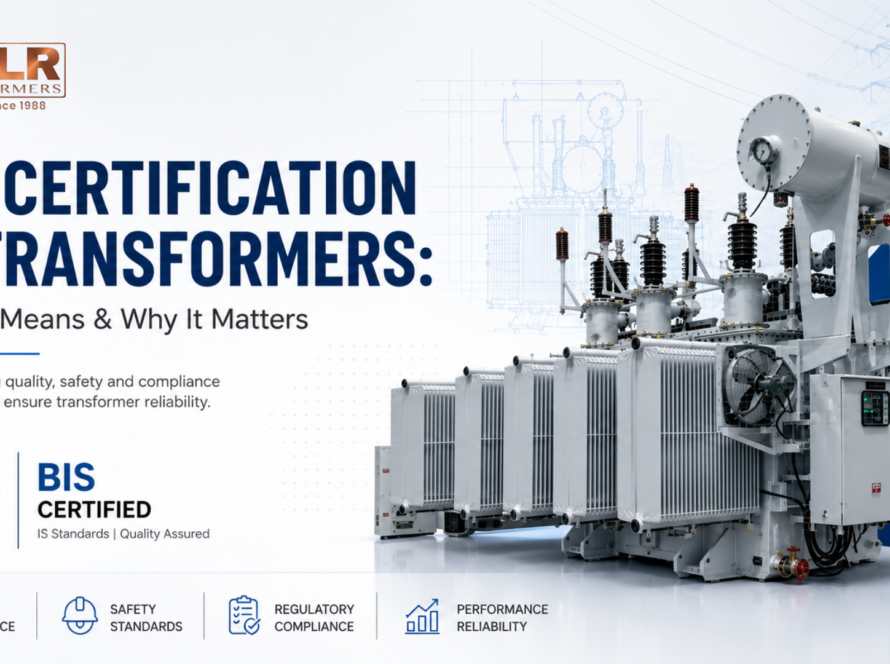
- Verify Certifications Before You Shortlist
- Confirm In-House Testing and Documentation
- Evaluate Cost of Ownership, Not Just Purchase Price
- Conclusion

1. Know Your Load Before You Specify Anything
Transformer sizing starts with your electrical load, not your installed capacity. The two are rarely the same. Most plants run at 60-75% of their total connected load at any given time, which means sizing to the nameplate ratings of all your equipment will almost always give you a transformer that is oversized and inefficient.
Calculate your realistic peak demand, apply a demand factor, and then add 15-20% headroom for future load growth. This gives you the rating to specify, unlike the sum of every motor, panel, and machine in your plant.
2. Match the Voltage Class to Your Supply and Distribution
Your transformer must step down from whatever voltage your DISCOM supplies at the plant boundary to the voltage your internal distribution operates at. In India, supply voltages commonly range from 11 kV to 132 kV depending on the utility and plant size. Secondary distribution within the plant is typically 415-433 V, or 11 kV for larger facilities with internal substations.
Confirm both figures, primary and secondary before specifying. Getting the voltage class wrong is not a field-adjustable problem.
3. Match the Transformer Type to Your Application
There is no single transformer that suits every industrial application. The type you specify should reflect the nature of your load and the operating conditions of your plant.
Transformer Types
| Type | Best For | Key Note |
|---|---|---|
| Power Transformer | Grid substations, large industrial plants | Higher voltage class, continuous base-load duty |
| Distribution Transformer | Plant rooms, factories, campuses | BIS certification mandatory in India |
| Solar Inverter Duty | Solar PV plants | Multi-winding; must handle harmonic loads |
| Furnace Transformer | Steel plants, foundries | Built for extreme duty; specialist design |
| Dry-Type Transformer | Data centres, hospitals, indoor use | Fire-safe; no oil required |
| Pad-Mounted Transformer | Underground distribution, export projects | ANSI/IEEE compliant for USA & Canada supply |
4. Account for the Installation Environment
A transformer specified for standard conditions and installed in a coastal plant, a high-altitude site, or an outdoor yard in a hot-climate state will underperform, sometimes significantly. Ambient temperature, altitude, humidity, and dust levels all affect how a transformer runs.
Share your site conditions with the manufacturer upfront. They should either confirm that the standard design is suitable or offer a derated or redesigned unit. The cooling method matters too: ONAN (Oil Natural, Air Natural) is the low-maintenance standard; ONAF (Oil Natural, Air Forced) adds fans for higher load capacity; OFAF (Oil Forced, Air Forced) and ODAF (Oil Directed, Air Forced) are used for large power transformers under heavy continuous duty.
5. Verify Certifications Before You Shortlist
Certifications are not a formality. They are the evidence that the manufacturer has been externally assessed and that the product meets the standards your project requires.
- BIS certification (IS 1180 Part 1): mandatory for distribution transformers on DISCOM and government-funded tenders in India. Verify the manufacturer’s licence number before proceeding.
- IS 2026 / IEC 60076: the applicable standards for power transformers. Confirm the manufacturer’s designs and test procedures are compliant.
- ISO 9001, 14001, 45001: quality, environment, and safety certifications of the manufacturing facility, not the product. They tell you how the company runs its operations.
- ANSI/IEEE (C57.12.26): required for pad-mounted transformers supplied to North American markets.
Ask for copies of current certificates, not brochure references. A credible supplier will provide them without hesitation.
6. Confirm In-House Testing and Documentation
Every transformer leaving a reputable factory should have been tested to the full routine test programme before dispatch. This is not optional, it is the verification that the unit performs to the specification you ordered.
Routine tests cover winding resistance, voltage ratio, no-load and load losses, impedance voltage, insulation resistance, and dielectric resistance. Ask for a sample test certificate from a recently dispatched unit in your rating range. The document will immediately tell you whether the supplier tests properly, what parameters they measure, and how complete their documentation is.
For larger or higher-criticality applications, ask whether type testing has been carried out and whether third-party NABL-accredited testing is available. A manufacturer with an in-house impulse testing facility is a step above in capability.
7. Evaluate Cost of Ownership, Not Just Purchase Price
A transformer operates for 25 to 40 years. The purchase price is the smallest number in that equation.
No-load losses, the energy the transformer consumes simply by being energised, regardless of what is connected add up every hour of every day for three decades. A transformer with lower no-load losses may cost more upfront, but the energy savings over its service life will typically far exceed the price premium.
Factor in the cost of maintenance (oil filtration, oil replacement, periodic inspection), and the risk-adjusted cost of failure in a running plant. An unplanned outage on a production line or a critical power supply costs far more than the margin between a quality supplier and a cheaper alternative.
Look for a manufacturer who offers Annual Maintenance Contracts (AMC), on-site servicing, and spare parts availability. These are indicators of a supplier who intends to stand behind their product for the long term.
Conclusion
Choosing the right transformer is an investment in your plant’s reliability, efficiency, and long-term performance. By considering load requirements, application, compliance, testing, and lifecycle costs, you can make a decision that delivers dependable service for decades. For high-quality power, distribution, and specialty transformers backed by advanced manufacturing and reliable after-sales support, explore KLR Transformers.
FAQ Section
Calculate your peak load demand by applying a demand factor (typically 60-75%) to your total connected load. Add 15-20% headroom for future growth. This gives a more accurate and cost-effective specification than simply summing all equipment nameplate ratings.
KLR Transformers offers a comprehensive range of power, distribution, and specialty transformers for industrial, utility, and renewable energy applications. With over 35 years of engineering expertise, a vertically integrated manufacturing facility, and comprehensive factory testing before dispatch, the company provides transformer solutions designed to meet diverse operational requirements.
BIS certification under IS 1180 (Part 1) is mandatory for distribution transformers supplied to DISCOM and government-funded tenders. For private procurement, it is considered a baseline quality standard and is increasingly required as a mandatory vendor criterion.
A proper factory test certificate should cover: winding resistance, voltage ratio, no-load and load losses, impedance voltage, insulation resistance, and dielectric withstand tests. For oil-immersed units, it should also include the oil BDV result. It should be signed by an authorised engineer and referenced to the transformer serial number.
ONAN (Oil Natural Air Natural) relies on natural oil convection and air movement around the radiators, no fans or pumps required. ONAF (Oil Natural Air Forced) adds fans to radiators to increase heat dissipation and allow a higher continuous load rating. ONAN is preferred for its simplicity; ONAF is used when higher capacity is needed from the same unit.
Transformers operate for 25-40 years. No-load losses accumulate every hour across that service life, and even modest savings in efficiency can translate to significant energy cost reductions. Factoring in maintenance costs and downtime risk almost always favours a quality manufacturer over the lowest-priced option.