
Introduction
Specifying the wrong transformer standard can delay commissioning, trigger costly redesigns, or lead to equipment being rejected during inspection or acceptance. If you’re purchasing power or distribution transformers for a project spanning North America, the Middle East, or India, understanding the relevant standards is essential. These include Indian Standards (IS), standards published by the International Electrotechnical Commission (IEC), and ANSI/IEEE standards, associated with the American National Standards Institute (ANSI) and the Institute of Electrical and Electronics Engineers (IEEE). Knowing which requirements apply to your project could make the difference between a successful rollout and costly delays.
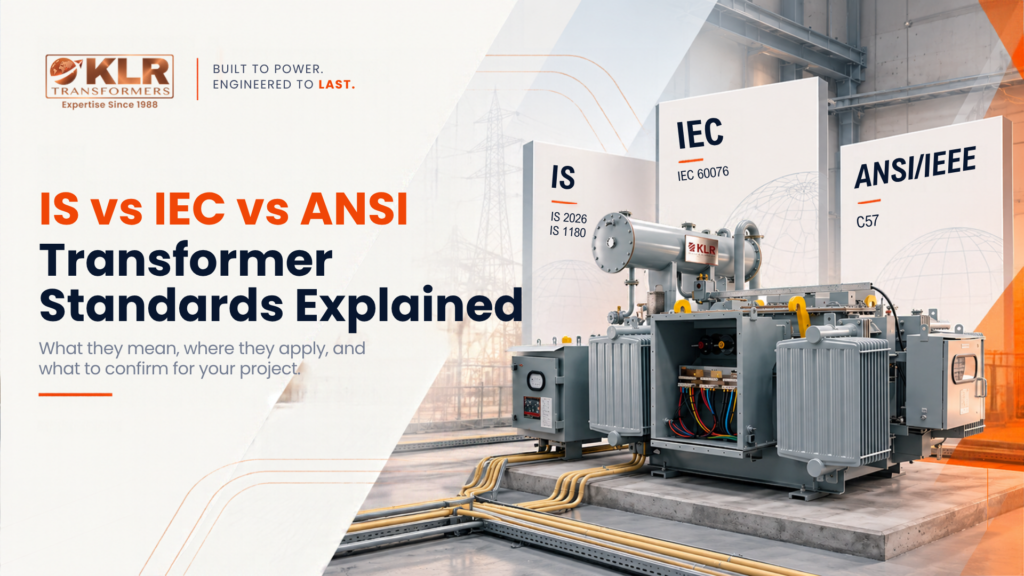
Every region builds its grid around different technical philosophies. India uses IS 2026 and IS 1180 for their respective applications. Many international projects follow IEC 60076, while North America uses ANSI/IEEE C57. Mixing these up means mismatched impedance values, incompatible tap changers, or transformers that may not pass local grid interconnection tests. In this guide, you’ll learn how IS, IEC and ANSI/IEEE standards differ, which ones may apply to your project, and what to check before finalising your transformer specifications.
Table of Contents:
- What Are Transformer Standards and Why Do They Differ?
- IS 2026: The Indian Standard
- IEC 60076: The Global Benchmark
- ANSI C57: The North American Standard
- Which Transformer Standard Does India Actually Require?
- Why Manufacturing Flexibility Matters for Multi-Standard Projects
- Common Mistakes When Specifying Transformer Standards
- Transformer Procurement Checklist
- Testing and Documentation: What Buyers Should Confirm
- Conclusion
What Are Transformer Standards and Why Do They Differ?
Transformer standards define the technical, safety, and testing requirements a transformer must meet before it can be connected to a grid. IS, IEC, and ANSI/IEEE differ in areas like voltage classes, insulation levels, temperature rise limits, and short-circuit withstand requirements, reflecting regional grid design philosophies developed over decades.
These differences influence transformer design, manufacturing, testing, documentation, and acceptance. The applicable standard must therefore be considered alongside the project’s technical specifications and operating conditions.
IS 2026: The Indian Standard
IS 2026 transformer specifications, published by the Bureau of Indian Standards (BIS), cover power transformers. IS 1180 applies to specified distribution transformers under its relevant parts. They should not be treated as interchangeable standards.
IS 2026 addresses requirements relating to rated values, temperature rise, insulation and dielectric testing, as specified in the applicable parts of the standard.
For Indian projects, the applicable standard and certification requirements depend on the transformer category, relevant regulations, and project specifications.
KLR Transformers offers BIS-certified distribution transformers for the Indian market, in accordance with the applicable requirements for these products.
IEC 60076: The Global Benchmark
IEC 60076 transformer standards, published by the International Electrotechnical Commission, are widely used across Europe, the Middle East, Africa, and much of Asia. IEC 60076 is a multi-part standard covering:
- General requirements (Part 1)
- Temperature rise (Part 2)
- Insulation levels and dielectric tests (Part 3)
- Lightning and switching impulse testing (Part 4)
Because many countries reference IEC 60076 directly or base national standards on it, it provides a common technical framework for international projects. However, the applicable parts and project-specific requirements must still be confirmed.
ANSI C57: The North American Standard
ANSI/IEEE C57 standards are widely used for transformer applications in North America. The applicable requirements depend on the transformer type, project specification and relevant utility requirements. Key differences from IEC include:
- Different voltage class structures and BIL (Basic Insulation Level) ratings
- Different temperature rise conventions
- Different test protocols for impulse and short-circuit withstand
IEC and ANSI/IEEE transformer requirements differ in several technical areas. For North American projects, buyers should confirm that the transformer design, accessories, ratings, nameplate information, and testing meet the applicable standards and utility requirements before procurement.
Which Transformer Standard Does India Actually Require?
The applicable transformer standard depends on the transformer type, installation, relevant regulations, and project specifications:
- Domestic utility and industrial projects: The applicable IS standards and any relevant BIS certification requirements should be confirmed for the transformer category.
- International EPC projects in India: IEC 60076 may be specified by the client, consultant, or project contract.
- Renewable energy projects: Additional or multiple standards may apply depending on grid codes, equipment interfaces, and project-specific requirements.
Confirm the applicable standards and certification obligations with the utility, EPC contractor, consultant, or project owner before finalising the transformer specification.
Side-by-side comparison
|
Why Manufacturing Flexibility Matters for Multi-Standard Projects
Global EPC contractors, renewable energy developers, and utilities may require transformers designed to meet specific national, international and project requirements, particularly for export projects or installations involving international equipment.
At KLR Transformers, we manufacture a range of transformers, from 500 kVA distribution units to power transformers rated up to 100 MVA. Our portfolio includes solutions designed to meet applicable IEC, IEEE and ANSI requirements, depending on the product and project specifications. We also offer BIS-certified transformers for applicable product categories in the Indian market and serve international markets, including the USA, Canada, Vietnam, Nepal and Africa.
Our quality credentials include:
- ISO 9001:2015 – Quality Management
- ISO 14001:2015 – Environmental Management
- ISO 45001:2018 – Occupational Health and Safety
- ISO 27001:2022 – Information Security Management
We also have factory testing facilities and conduct routine testing as part of our quality-control processes.
Our engineering heritage dates back to 1988, and in 2010, our Chairman, Shri K. Linga Reddy, received the National Award for Best Quality Transformers. This legacy continues to inform our approach to transformer manufacturing, with a focus on quality, reliability and meeting project-specific requirements.
Common Mistakes When Specifying Transformer Standards
- Assuming IEC and ANSI/IEEE requirements are interchangeable: Requirements for bushings, insulation levels, BIL ratings and other design parameters may differ between applicable standards.
- Overlooking project-specific requirements: Renewable energy, utility and export projects may have additional technical, grid-code or contractual requirements.
- Providing incomplete technical specifications: Missing details such as voltage ratings, frequency, impedance and tap range can lead to clarification requests or design revisions.
- Ignoring testing and documentation requirements: Confirm the required test reports, inspection records and documentation before production begins.
- Failing to specify the applicable standard edition: Identify the relevant standard, edition and any project-specific amendments in the procurement specification.
- Assuming BIS certification alone satisfies export requirements: Verify the applicable standards, certification requirements and project specifications for the destination market.
Transformer Procurement Checklist
Before requesting a quotation, confirm:
- Required standard and applicable edition
- Rated capacity (kVA/MVA), primary and secondary voltage
- Frequency (50 Hz or 60 Hz) and single-phase or three-phase configuration
- Vector group, impedance, and tapping range
- Cooling method and loss or energy-efficiency requirements
- Ambient temperature, altitude, humidity, dust, and corrosive exposure
- Indoor or outdoor installation and applicable enclosure or protection requirements
- Required tests, inspection arrangements, and documentation
Operating conditions can affect cooling requirements, insulation coordination, protection, and other design decisions. Providing these details early helps the manufacturer assess the application accurately.
Testing and Documentation: What Buyers Should Confirm
Transformer testing and documentation requirements depend on the transformer type, applicable standard, and project specification.
- Routine tests: Performed on each individual transformer as required by the applicable standard.
- Type tests: Demonstrate that a representative design meets specified requirements.
- Special tests: Conducted when required by the applicable standard, project specification, or agreement between the buyer and manufacturer.
Before production, agree on the required tests and reports, including any factory acceptance testing (FAT) or witness inspection arrangements.
Depending on the project, documentation may include the approved technical datasheet and drawings, the applicable standard and edition, unit-specific routine test reports, relevant type-test reports, nameplate details, declared ratings, inspection records, and installation, operation, and maintenance documentation.
Dual-standard compliance should be confirmed against the actual requirements of both standards, the agreed technical specification, and the intended installation. A manufacturer’s reference to multiple standards alone does not establish that a particular transformer meets all project requirements.
Conclusion
Choosing the right transformer standard starts with understanding your project’s technical requirements, operating conditions and applicable compliance obligations. Before finalising your specifications, ensure that the selected transformer aligns with the relevant IS, IEC or ANSI/IEEE requirements for your application.
At KLR Transformers, we offer transformer solutions based on the standards and technical specifications relevant to each project.
Planning your next transformer project? Get in touch with our team to discuss your technical requirements and explore a suitable transformer solution for your application.
FAQ Section
IS standards apply to relevant Indian transformer categories, IEC 60076 is widely used internationally, and ANSI/IEEE C57 standards are important in North America. They differ in technical requirements, insulation levels, temperature rise, and testing.
Yes, where it is specifically designed and verified against the applicable requirements. Confirm the standards and project specifications with the manufacturer.
Routine tests check each individual unit as required by the applicable standard. Type tests demonstrate that a representative design meets specified requirements. Special tests are conducted when required or agreed.
Confirm the approved datasheet and drawings, applicable standard and edition, required test reports, nameplate information, inspection records, and other documentation specified in the contract.
Ambient temperature, altitude, humidity, dust, corrosive exposure, and indoor or outdoor installation can influence cooling, insulation coordination, enclosure selection, and other design requirements.
Check the utility requirements, applicable regulations, EPC contract, equipment interfaces, and project specifications before finalising the order.