
Introduction
Can the same transformer run both an induction furnace and an arc furnace? Usually not, even when both use the same amount of power.
A furnace transformer takes high-voltage power from the grid and converts it to the lower voltage your furnace equipment can use. But the right transformer depends on the furnace. Induction and arc furnaces use power in very different ways, and a transformer built for one can struggle with the other.
So before you ask for quotes, find out what kind of load your transformer will carry. This guide explains the difference, how to size each type, and what to tell suppliers so every quote is on the same basis.
Table of Contents:
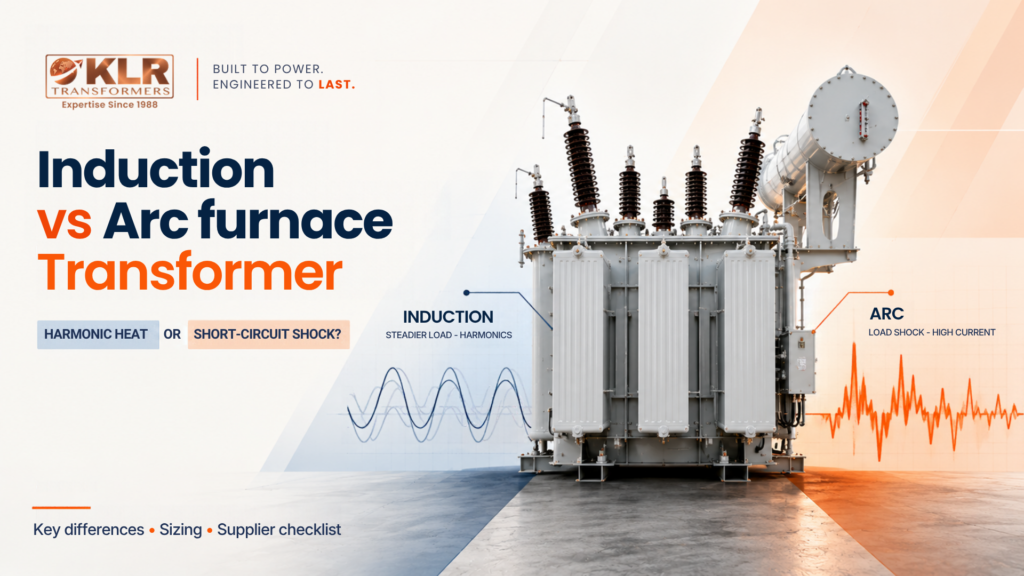
The Core Difference: Steady Load vs Shock Load
An induction furnace runs through a power supply (a rectifier and an inverter) that keeps the load steady. The catch is harmonics: extra currents that make the transformer run hotter. So an induction furnace transformer is built to handle heat.
An arc furnace melts scrap with an electric arc between electrodes. When scrap collapses onto the electrodes, it causes a near short-circuit, and this happens many times in one melt. So an arc furnace transformer is built to handle mechanical shock and very high current.
|
“Arc furnace” here covers both the electric arc furnace (EAF), which melts scrap, and the ladle refining furnace (LRF), which reheats and fine-tunes molten steel after melting. A tap changer is a switch that adjusts the transformer’s output voltage.
Induction Furnace Transformers: Built for Harmonic Heat
An induction furnace transformer never connects to the furnace coil directly. It feeds a power supply that turns grid AC into DC (the rectifier), then into medium-frequency AC for the coil (the inverter). The inverter controls melt power, not the transformer.
That keeps the load steady, but not clean. The rectifier draws harmonics, which are extra currents at multiples of the grid frequency, and they add heat inside the transformer. Designers deal with this in two ways:
- Multi-pulse design. Two secondary windings are set 30° apart so their harmonics partly cancel out. A 12-pulse design does this with one star and one delta winding in the same tank. A 24-pulse design adds more windings to cut harmonics further.
- Harmonic-rated design. Conductors and structural parts are sized for the real harmonic load, using the K-factor approach in IEEE C57.110. This keeps the transformer within its temperature limits at full load.
IEC 61378-1 covers converter transformers for industrial use.
Arc Furnace Transformers: Built for Shock and High Current
An arc furnace melts scrap steel, which is old steel from things like used machinery, vehicles and construction waste, and recycles it into new steel. It does this with an electric arc: a powerful spark that jumps from large graphite rods, called electrodes, to the metal. The arc produces the intense heat that melts the scrap.
The transformer feeds these electrodes through heavy flexible cables. At the start of melting, called bore-in, the electrodes bore down into the pile of scrap. Pieces of scrap often collapse onto the electrodes and touch them directly, which causes a near short-circuit. One heat (a full melting cycle) can have dozens of these.
The transformer also has to deliver very high current at low voltage, up to tens of thousands of amps in large furnaces. This creates strong magnetic forces and heat inside the transformer, so the design focuses on three things:
- A strong mechanical build. The windings are braced so they aren’t moved or damaged by the forces from repeated short-circuits.
- Copper windings and connections sized for the current and heat.
- Cooling that suits the site. Many arc furnace transformers use OFWF (oil forced, water forced): pumps push the transformer’s oil through coolers, where water carries the heat away.
Ladle refining furnace (LRF) transformers follow the same approach at lower ratings. An LRF reheats and fine-tunes molten steel after melting, so these transformers have finer voltage steps for temperature control.
Tap Changer: Off-Circuit or On-Load?
The tap changer is where the two furnaces differ most.
- Induction: off-circuit tap changer (OCTC). The inverter controls melt power, so taps only adjust for changes in supply voltage. They are set rarely, with the transformer switched off. An OCTC is simple, lower in cost and needs little maintenance.
- Arc: on-load tap changer (OLTC). Arc power depends on voltage, and many furnaces change voltage as the heat moves from bore-in to melting to refining. An OLTC changes taps while the transformer is running. In a furnace it switches far more often than in a normal grid transformer, so it must be rated for that duty.
Tip: State how many tap changes you expect per day in your enquiry. It lets the supplier rate the OLTC correctly and set realistic maintenance intervals.
How to Size a Furnace Transformer
Start with the furnace, not the transformer catalogue. The figures below are first estimates, and the final rating should be confirmed with the furnace supplier.
Induction furnaces. If the stated furnace kW is useful output power, a first estimate is:
Required kVA = Furnace kW ÷ (power factor × efficiency) × harmonic margin
A harmonic margin of 1.05 to 1.10 is sometimes used as a starting point. It is not a universal rule, because the right margin depends on the actual harmonics and the transformer design.
For example, a 4,000 kW furnace at 0.95 power factor and 95% efficiency needs about 4,432 kVA before any margin. With a 1.05 margin that becomes about 4,654 kVA, and with 1.10 about 4,875 kVA. Don’t add a separate margin if the specified transformer rating already includes harmonics.
Arc furnaces (EAF and LRF). No single MVA-per-tonne figure fits every arc furnace. The rating depends on how much steel you melt per heat, how fast you need to melt it, and the furnace supplier’s power programme (the planned power setting for each stage of the melt). Get the rating from your furnace supplier, then confirm it with the transformer manufacturer.
What to Tell Suppliers
Give every supplier the same details, so the quotes are comparable:
- Furnace type, capacity (tonnes) and make
- Induction: power-supply rating (kW), pulse number and harmonic data
- Arc: secondary voltage range, current, number of taps and tap changes per day
- Primary voltage and fault level at the connection point (how much short-circuit current the grid can supply there)
- Cooling preference, plus water quality and temperature
- Site layout and any installation limits
Also state the standards the transformer must be built and tested to. IS 12977 covers arc furnace transformers in India, and IEC 61378-1 covers converter transformers used with induction furnaces. IS 2026 and IEC 60076 may apply as general standards. Confirm the editions with your supplier. For a fuller buying checklist, see our guide, Furnace Transformer Specification: A Buyer’s Guide.
Conclusion
- Induction: steady load, harmonic heat. The transformer must be designed for the harmonics, and usually has an off-circuit tap changer.
- Arc: uneven load, short-circuit shocks. The transformer needs a strong build, suitable cooling and usually an on-load tap changer.
- Sizing: start with the furnace, then confirm the rating with the furnace supplier and the transformer manufacturer.
KLR Transformers works with furnace customers on both induction and arc furnace applications. Our manufacturing legacy began in 1988, and our engineering team supports you from specification through to after-sales service.
Planning a new installation or upgrading your existing setup? Share your furnace details and talk to our engineers about the right transformer for your melt shop.
FAQ Section
It is usually not recommended. A rectifier-based power supply creates harmonics, which add heat inside the transformer. The transformer should be specified for the actual harmonic load, often with a converter-duty design and a multi-pulse secondary.
When the furnace needs voltage changes during a heat without switching the transformer off. The voltage needs often change as the heat moves through bore-in, meltdown and refining. The OLTC must be rated for that duty.
No single MVA-per-tonne figure fits every furnace. The rating depends on furnace capacity, production rate, voltage and current needs, operating profile and the plant’s electrical system. Confirm it against the furnace supplier’s power programme and a site electrical study.
OFWF stands for Oil Forced, Water Forced. Pumps move transformer oil through oil-to-water coolers, where cooling water carries the heat away. It removes a lot of heat in a compact space, but it needs a reliable supply of cooling water that meets the design requirements.
A 12-pulse transformer has two secondary windings in one tank, one star-connected and one delta-connected, set 30° apart. Each feeds a six-pulse rectifier, and together they cancel much of the 5th and 7th harmonics on the grid side. A 24-pulse design adds more phase-shifted windings to reduce harmonics further.
It depends on the transformer duty and the agreed specification. IS 12977:1990 covers arc furnace transformers. IEC 61378-1 may apply to induction furnace transformers used with converter systems, and IS 2026 / IEC 60076 may apply too. Confirm the editions and test requirements with your supplier.