
A Transformer Doesn't Fail Overnight. It Fails Quietly, Then Suddenly.
A transformer is a critical asset in any industrial plant or commercial facility. When it fails unexpectedly, the result can be production downtime, equipment damage, safety risks, and costly repairs.
That’s the story a transformer AMC in India is written to prevent.
A transformer annual maintenance contract isn’t paperwork you sign and forget. It’s a structured commitment, scheduled visits, diagnostic tests, and documented health checks – built around the one asset your entire operation quietly depends on. If you’re a plant owner, facility manager, or operations head weighing whether this is worth budgeting for, this guide walks through exactly what a transformer AMC covers, what it costs you to skip one, and how to choose a transformer maintenance service that actually holds up.
Table of Contents:
What Is a Transformer AMC in India?
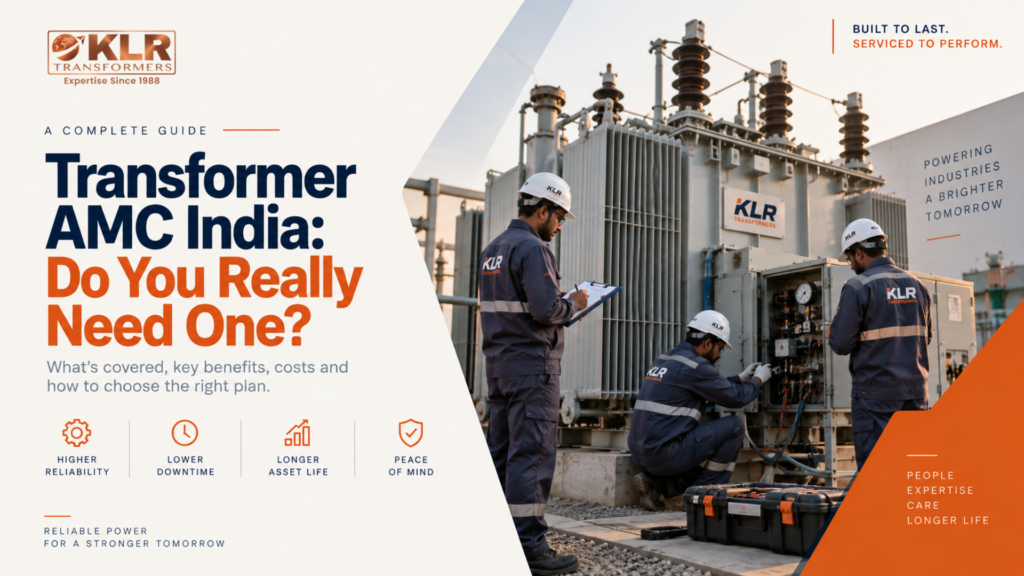
A transformer AMC (Annual Maintenance Contract) is a service agreement between a facility and a qualified transformer service provider, covering scheduled inspections, diagnostic testing, and preventive maintenance across a defined period, typically one year.
Instead of calling for help only when something breaks, an AMC puts your transformer on a calendar. Trained engineers visit at fixed intervals, run diagnostic tests, flag early warning signs, and document the transformer’s condition over time, building a health record that reactive repairs never give you.
Most providers offer visit frequencies based on load criticality and site conditions, commonly structured as 1, 2, or 4 scheduled visits per year, depending on the facility’s requirements.
Why Transformers Fail - And Why It's Rarely Sudden
Transformer failure is almost never a single event. It’s usually the end point of a slow chain most people never see:
- Moisture ingress that quietly degrades insulation over months
- Declining Breakdown Voltage (BDV) in the oil, reducing its ability to insulate
- Winding resistance drift from thermal stress and age
- Loose or degraded connections that generate heat under load
- Dissolved gases building up inside the oil – an early signature of internal faults
Each of these shows up as data long before it shows up as downtime. A dissolving gas analysis (DGA) test is a good example. It can detect an imminent fault even though the transformer is operating normal. In the absence of this test the fault would surface just when it is triggered typically at the most inconvenient time.
The Real Cost of Skipping a Transformer AMC
For most industrial and commercial facilities, an unplanned transformer outage doesn’t just stop one machine, it stops the line, the shift, sometimes the day. Add emergency service call-outs, expedited part sourcing, and potential safety exposure, and the real cost of “we’ll deal with it if it breaks” is rarely small.
Compare that to the cost of a routine AMC visit: a fraction of a single emergency callout, spread predictably across the year.
Transformer AMC Benefits: What You're Actually Paying For
1. Early Fault Detection
Diagnostic testing – DGA, BDV, insulation resistance, winding resistance – catches problems while they’re still cheap to fix.
2. Extended Transformer Lifespan
Transformers are capital assets built to run for decades. Consistent maintenance protects that investment instead of letting avoidable wear shorten it.
3. Reduced Unplanned Downtime
Scheduled checks catch degrading components before they force an unscheduled shutdown.
4. Regulatory and Safety Compliance
Documented maintenance records support compliance requirements and reduce liability exposure in the event of an incident.
5. On-Site Oil Restoration
Modern transformer maintenance service providers can now restore degraded transformer oil on-site, using mobile hot oil circulation and vacuum filtration units to bring Breakdown Voltage back to acceptable levels without removing the transformer from service.
6. One Provider, Any Brand
A well-equipped AMC provider services both their own manufactured units and third-party transformer makes, so a multi-brand facility isn’t managing multiple vendor relationships.
What Should Be Included in a Transformer AMC?
A thorough transformer AMC visit typically includes Dissolved Gas Analysis (DGA), Breakdown Voltage (BDV) and moisture testing, Insulation Resistance (IR) and Winding Resistance testing, ratio and vector group polarity checks, and Buchholz/PRD relay trip logic verification, together forming a complete diagnostic picture of transformer health.
Beyond testing, a solid AMC should specify:
- Number of visits per year (1, 2, or 4, based on criticality)
- Response time commitments for urgent issues
- Whether oil processing/reconditioning is included
- Documentation and reporting after each visit
- Coverage for both KLR-manufactured and third-party transformers
Choosing the Right Transformer Maintenance Service
Not every AMC provider brings the same depth. Before signing, it’s worth asking:
- Does the provider have in-house testing infrastructure, or do they outsource diagnostics?
- Can they perform on-site oil reconditioning, or does the transformer need to be shipped out?
- Do they service multiple transformer brands, or only their own?
- What certifications back their process – ISO 9001, ISO 45001, BIS compliance?
- Is there a dedicated service contact, or a generic support line?
For industrial installations, Transformer maintenance must be more than regular inspections. A skilled technician can spot warning signs of overheating problems with insulation, degraded oil and other possible faults.
KLR Transformers combines transformer engineering expertise with preventive maintenance and diagnostics to help businesses improve transformer reliability and reduce unexpected downtime.
The right AMC provider should offer more than a checklist–it should provide technical expertise and a clear understanding of your transformer’s health.
Key Takeaways
- A transformer AMC replaces reactive repair with scheduled, documented maintenance
- Most failures show early warning signs – diagnostic testing catches them before they become downtime
- On-site oil reconditioning means less disruption and no transformer removal
- The right provider services any brand, not just their own
- The cost of an AMC is consistently smaller than the cost of one unplanned outage
Your transformer runs quietly in the background of everything your facility does, until it doesn’t. A structured AMC keeps it that way: quiet, dependable, and off your list of things to worry about.
Ready to build a maintenance schedule around your facility’s needs? Talk to KLR Transformers’ service team to scope out an AMC that fits your load, your site, and your budget.
FAQ Section
Most facilities schedule 1, 2, or 4 visits per year, depending on load criticality, transformer age, and site conditions. High-load or older transformers typically warrant more frequent visits, while newer, lower-risk units may need only one annual check.
Yes. Established providers service both their own manufactured units and third-party transformer makes, offering on-site testing, servicing, and reconditioning regardless of the original manufacturer.
DGA measures gases dissolved in transformer oil to detect internal faults like overheating or arcing, often before they cause visible damage. It’s one of the earliest and most reliable indicators of developing transformer problems.
Not always. Degraded oil can often be restored on-site using hot oil circulation and vacuum filtration, which improves Breakdown Voltage without removing the transformer or fully replacing the oil.
Costs vary by transformer capacity, visit frequency, and service scope. However, an AMC consistently costs a fraction of a single unplanned outage or emergency repair, making it a predictable, budgeted expense rather than a crisis cost.
It’s not legally mandatory in most cases, but it’s strongly recommended for regulatory compliance, safety documentation, and warranty support, and it materially reduces the risk of unplanned downtime.
An AMC is preventive and scheduled, catching issues early through regular testing. One-off repairs are reactive, addressing problems only after they’ve already caused a failure or performance drop.