
A Complete Preventive Maintenance Guide for Industrial Facilities
A dry type transformer failure in a pharmaceutical plant, data centre, or hospital does not give you warning signs the way an oil-cooled unit does. There is no Buchholz relay alarm, no rising oil temperature gauge, no conservator level drop. The failure simply happens, and in a sensitive installation, the downstream consequences are immediate and severe.
Dry type transformers are designed for reliable operation without the oil-related maintenance required by oil-filled transformers. However, they still require planned inspection, cleaning, temperature monitoring, connection checks and electrical testing. Dust accumulation, restricted ventilation, loose connections, insulation deterioration and cooling-system problems can affect transformer performance if they are not identified in time.
This practical dry type transformer maintenance checklist is intended as a reference for plant engineers, electrical maintenance teams and facility operators. Maintenance frequency and test requirements should always be adjusted according to transformer design, operating conditions, environmental conditions, manufacturer recommendations and applicable standards.
Table of Contents:
- What Is Dry Type Transformer Maintenance?
- Why Do Dry Type Transformers Need Regular Maintenance?
- Dry Type Transformer Maintenance Checklist
- Dry Type Transformer Electrical Testing
- Dry Type Transformer Maintenance Schedule
- Warning Signs That a Dry Type Transformer Needs Attention
- Maintenance Documentation: What to Record
- KLR Transformers Dry Type Transformer Solutions
What Is Dry Type Transformer Maintenance?
Dry type transformer maintenance is the planned inspection, cleaning, testing and condition monitoring of a transformer that uses solid insulation and air rather than insulating liquid as its primary insulation medium. Typical maintenance activities include visual inspection, dust removal, ventilation checks, temperature and load monitoring, electrical connection inspection, insulation resistance testing and other diagnostic tests where applicable.
The purpose is to identify developing conditions before they result in overheating, insulation deterioration, unexpected trips or unplanned outages.
Why Do Dry Type Transformers Need Regular Maintenance?
Although dry type transformers do not require oil sampling, oil filtration, conservator inspection or breather maintenance, they have their own maintenance requirements.
- Dust and contamination can accumulate on insulation surfaces and affect electrical performance.
- Restricted ventilation can increase operating temperature.
- Thermal cycling can contribute to loosening of electrical connections.
- Moisture and environmental contamination can affect insulation and enclosure conditions.
- Cooling fans, where provided, require inspection and functional checks.
- Abnormal temperature, noise, vibration or discoloration can indicate developing problems.
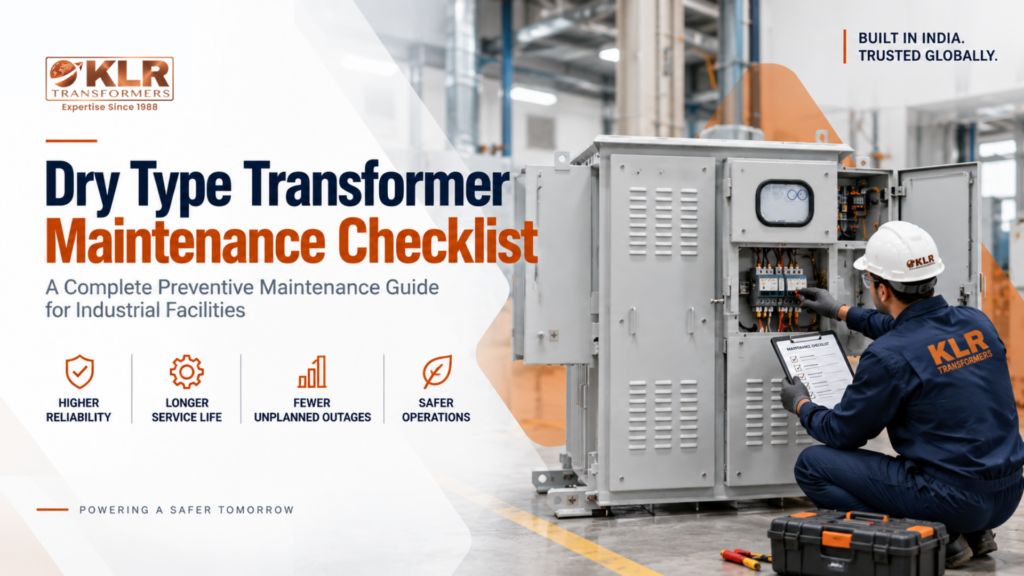
Dry Type Transformer Maintenance Checklist
Use the following checklist as a practical framework. Do not treat the listed frequencies as universal mandatory intervals; the actual maintenance programme should follow the transformer manufacturer’s recommendations and site conditions.
- Routine Visual Inspection
- Check the transformer enclosure for physical damage, corrosion or signs of pest ingress.
- Look for discoloration, burning marks, unusual smell or other signs of overheating.
- Check winding temperature indicators and compare readings with previous observations.
- Verify alarm and trip indications on the temperature monitoring system, where provided.
- Listen for unusual noise or vibration.
- Check that ventilation openings are unobstructed.
- Observe the surrounding area for water ingress, excessive dust or other environmental concerns.
- Cleaning and Ventilation
- Inspect ventilation grilles, louvers and air-intake filters where provided.
- Remove accumulated dust using a suitable dry-cleaning method recommended by the manufacturer.
- Keep ventilation paths clear so that cooling air can circulate properly.
- Inspect accessible surfaces for excessive dust, contamination, tracking or other visible abnormalities.
- Check enclosure seals, doors and cable-entry areas for deterioration where applicable.
Cleaning near energized electrical equipment should only be performed when the method is specifically permitted by the equipment manufacturer and site safety procedures. Internal cleaning and maintenance requiring access to the transformer should be performed after appropriate isolation and lockout/tagout.
- Temperature and Load Monitoring
- Record transformer load current and compare it with the transformer’s rated capacity.
- Monitor winding temperature and look for sustained or abnormal temperature increases.
- Review temperature trends rather than relying only on a single reading.
- Check cooling fan operation where the transformer is equipped with forced cooling.
- Check the ambient conditions around the transformer and investigate inadequate ventilation.
- If plant load has increased substantially, have the transformer loading and capacity reviewed by a qualified electrical engineer.
- Electrical Connections and Earthing
- Inspect HV cable terminations and accessible connections for signs of overheating or corrosion.
- Inspect LV cable and busbar connections.
- Check earthing connections and their physical condition.
- Check connection tightness according to the transformer manufacturer’s specified torque values.
- Investigate discoloration, arcing marks, corrosion or other evidence of connection heating.
- Cooling System and Fan Checks
Where forced cooling is provided, cooling equipment should be included in the maintenance programme.
- Check fan operation and abnormal noise.
- Inspect fan airflow and ventilation paths.
- Check fan controls and alarms where provided.
- Inspect fan motors and associated electrical connections during scheduled shutdown maintenance.
- Follow the manufacturer’s instructions for fan bearing, motor and replacement requirements.
Dry Type Transformer Electrical Testing
Electrical and diagnostic testing should be selected according to transformer design, manufacturer recommendations, operating history and applicable testing standards. Testing should be performed by qualified personnel using appropriate procedures and instruments.
Insulation Resistance (IR) Test
An insulation resistance test helps assess the condition of the transformer insulation system. Measurements may be taken between windings and earth and between windings as applicable to the transformer design and test procedure.
Record the test voltage, instrument details, temperature and measured values. Comparing results with previous readings is particularly useful because a significant deterioration trend can indicate a developing insulation problem. Acceptance criteria should be based on the manufacturer’s instructions, applicable standards and historical test data rather than a single universal resistance value.
Winding Resistance Test
Winding resistance measurement can help identify abnormalities associated with windings and connections. Results should be compared with factory test records and previous measurements, taking temperature and the applicable test method into account.
Thermal Imaging / Thermography
Infrared thermography can help identify abnormal heating at electrical connections and other accessible components while the transformer is operating under representative load. Thermal images should be interpreted by a qualified person and compared with suitable reference points, previous inspection results and manufacturer or site criteria.
Partial Discharge Testing
Partial discharge testing may be used as a specialist diagnostic technique for assessing insulation condition, particularly where insulation degradation is suspected or where the transformer manufacturer’s maintenance programme calls for it. Test methods and acceptance criteria should follow the applicable standard and manufacturer requirements.
Other Diagnostic Tests
Depending on transformer design and maintenance requirements, additional tests may include tan delta/dissipation factor, turns ratio or other condition-assessment tests. These should not be treated as mandatory for every dry type transformer.
Dry Type Transformer Maintenance Schedule
Frequency | Typical activities |
Routine / Weekly | Visual condition, load, temperature, alarms, ventilation and unusual noise/vibration. |
Monthly | Cleaning and ventilation checks, temperature trends, enclosure condition and cooling-system observations. |
Quarterly / Periodic | Electrical connections, earthing, scheduled IR testing, internal inspection and cooling-system functional checks where applicable. |
Annual / Major Inspection | Thermography, selected diagnostic tests, detailed mechanical inspection, protection/alarm checks and review of maintenance records. |
The actual interval should be determined from transformer design, operating conditions, loading, environmental exposure, manufacturer recommendations and site maintenance procedures. Harsher environments or unusual operating conditions may require more frequent inspection.
Warning Signs That a Dry Type Transformer Needs Attention
- Abnormal or increasing winding temperature
- Repeated temperature alarms or protection trips
- Burning smell or visible discoloration
- Unusual noise or vibration
- Excessive dust or contamination
- Tracking, carbonization or visible insulation damage
- Cracks or other physical damage to cast-resin surfaces, where applicable.
- Loose, corroded or overheated connections
- Significant deterioration in insulation resistance
- Abnormal thermal hotspots
- Cooling fan failure or inadequate airflow
Maintenance Documentation: What to Record
Every inspection, test result, and maintenance action must be recorded in a transformer maintenance log. As a minimum, the log should capture:
- Date and time of inspection
- Transformer identification (feeder designation, kVA rating, serial number)
- Load current and WTI readings at time of inspection
- IR test results (instrument details, test voltage, and all winding readings)
- Any anomalies observed and corrective actions taken
- Name of person conducting the inspection
A maintenance log serves two purposes: it enables trend analysis that identifies degradation before failure, and it is required documentation for insurance purposes
KLR Transformers Dry Type Transformer Solutions
KLR Transformers manufactures and supplies transformer solutions across power, distribution and special applications. KLR also states that it provides lifecycle support including Annual Maintenance Contracts (AMC), on-site servicing, testing, troubleshooting and transformer reconditioning. This service capability can support planned maintenance as well as condition assessment and fault investigation.
For a dry type transformer maintenance requirement, customers can share the transformer rating, installation details, operating conditions and maintenance history with KLR’s engineering team for an appropriate service assessment.
Conclusion
Dry type transformers are designed for reliable operation, but they are not maintenance-free. Regular inspection, cleaning, temperature and load monitoring, connection checks and appropriate electrical testing can help identify developing issues before they result in unplanned outages.
KLR Transformers provides transformer maintenance, testing and Annual Maintenance Contract support. Share your transformer rating, installation details and maintenance requirement with the KLR engineering team to discuss the appropriate next step.Click Here
FAQ Section
There is no single interval that applies to every dry type transformer. The maintenance schedule should consider transformer design, loading, environment, operating history and manufacturer recommendations. Routine condition checks can be combined with periodic detailed inspection and testing.
Typical activities include visual inspection, cleaning, ventilation checks, temperature and load monitoring, connection and earthing inspection, cooling-system checks and selected electrical or diagnostic tests.
IR testing can be an important condition-assessment test, but the test frequency and procedure should be determined according to the transformer design, manufacturer recommendations and applicable testing requirements.
Cleaning should follow the manufacturer’s instructions and site electrical-safety procedures. Dust and contamination should be removed using an approved dry cleaning method. Internal cleaning that requires access to the equipment should be performed after appropriate isolation, lockout/tagout and earthing.
Depending on the transformer and maintenance programme, tests can include insulation resistance, winding resistance, thermal imaging, partial discharge and other diagnostic tests such as turns ratio or tan delta where applicable.
Common warning signs include abnormal temperature rise, repeated alarms, unusual noise or vibration, burning smell, discoloration, excessive dust, tracking, insulation damage, abnormal test results and overheating at connections.
Dry type transformers can use different insulation and construction approaches. Cast-resin transformers use resin-encapsulated windings, while other designs use different insulation systems. Maintenance requirements should be based on the specific transformer construction and manufacturer’s instructions.